

From a council estate in Stevenage to the most decorated driver in Formula 1 history, Lewis Hamilton’s career is a story of defiance, resilience, and relentless greatness. This is how a boy who wasn’t supposed to be here rewrote every record in the book.
There is a tattoo across Lewis Hamilton’s shoulders. Three words, borrowed from the poet Maya Angelou, that have defined everything he has ever done behind the wheel of a Formula 1 car: Still I Rise.
They are not just words. They are a prophecy. A battle cry. A lived truth. Because everything about Lewis Carl Davidson Hamilton — from the council estate where he grew up, to the seven world championships he has won, to the scarlet Ferrari overalls he wears today at the age of 41 — has been an act of rising against what was expected, what was permitted, and what the world thought possible.
His is not merely the story of the most successful driver in the history of Formula 1. It is the story of a boy who walked into the most exclusive sport on the planet — a world of billionaire families, inherited privilege, and generational wealth — with nothing but a second-hand go-kart, a father who worked three jobs, and an unshakable belief that he belonged.
He more than belonged. He conquered.
The Boy From Stevenage
Lewis Hamilton was born on January 7, 1985, in Stevenage, Hertfordshire — a working-class town north of London that has never been confused with Monte Carlo or Maranello. His father Anthony, of Afro-Grenadian descent, and his mother Carmen Larbalestier, who is white British, separated when Lewis was two years old. He lived with his mother and two half-sisters for the first years of his life, spending weekends with his father — weekends that would change the trajectory of motorsport forever.
Anthony Hamilton was not a wealthy man. He was an information technology manager who, at various points in Lewis’s childhood, held down as many as three jobs simultaneously to fund his son’s racing ambitions. When Lewis was five, Anthony gave him a radio-controlled car. The boy finished second in the national championship — against adults. A year later, Anthony bought him a go-kart for Christmas, with a promise attached: he would support Lewis’s racing career for as long as Lewis worked hard at school.

That promise held. And it cost everything.
Lewis was the only Black child at his karting club. He was subjected to racist abuse from the beginning — slurs shouted across the paddock, bananas thrown in his direction, the casual cruelty of a sport that had never seen anyone who looked like him. At school, he was one of only three children of color. He was bullied, picked last in sports, called names that no child should ever hear.
But Anthony Hamilton did not let his son quit. He drove Lewis across England in the back of a van, sleeping in car parks, wrenching on the kart himself, pouring every spare pound into entry fees and tires and fuel. The smell of that fuel — the cold mornings, the scruffy trailers, the father and son alone against the world — those memories would stay with Lewis forever.
“Those were the best days,” Hamilton would later say. “Helping my dad mechanic. As a kid, those were the best days because you feel like you’re doing something with your dad.”
At ten years old, Lewis attended the Autosport Awards in London. He walked up to Ron Dennis, the chief executive of McLaren, and told him — with the unblinking confidence that would become his trademark — that he wanted to race for his team one day. Dennis wrote in his autograph book: “Phone me in nine years, we’ll sort something out.”
He didn’t have to wait nine years. By 1998, at just thirteen, McLaren signed Lewis Hamilton to their Young Driver Programme, making him the youngest driver ever admitted. The financial burden was finally lifted from Anthony’s shoulders. The dream had a foundation.
The Rookie Who Shook the World
Hamilton did not creep into Formula 1. He detonated.
After dominating the junior categories — winning the Formula Renault UK Championship, the Formula 3 Euro Series, and the GP2 Series in consecutive years — Hamilton made his F1 debut with McLaren at the 2007 Australian Grand Prix. He was 22 years old, and he was the first Black driver to ever race in Formula 1.
What followed was arguably the greatest rookie season the sport has ever witnessed. Hamilton won four races, stood on the podium nine times, and led the championship for much of the year. He was paired with Fernando Alonso — the reigning two-time world champion — and matched him blow for blow. The tension between them became one of the defining storylines of the season, culminating in a toxic team dynamic that saw McLaren implode from within.
Hamilton finished the season tied on points with Alonso and just one point behind champion Kimi Räikkönen. He had come within a whisper of winning the title in his very first year. The sport had never seen anything like it.
But 2008 would deliver what 2007 had promised.
In one of the most dramatic finales in F1 history, Hamilton arrived at the Brazilian Grand Prix needing to finish fifth or higher to clinch the championship. With rain hammering Interlagos and the race falling apart around him, Hamilton found himself in sixth place on the final lap — one position short of the title. Felipe Massa crossed the line first, and for 38 agonizing seconds, the Brazilian crowd erupted, believing their man had won the championship.
Then, on the very last corner of the very last lap, Hamilton overtook Timo Glock’s struggling Toyota and crossed the line in fifth. By a single point. The youngest world champion in Formula 1 history at the age of 23.
His father was waiting for him in parc fermé. They embraced — a father who had worked three jobs and a son who had just conquered the world. It remains one of the most powerful images in the history of the sport.
The Gamble That Changed Everything
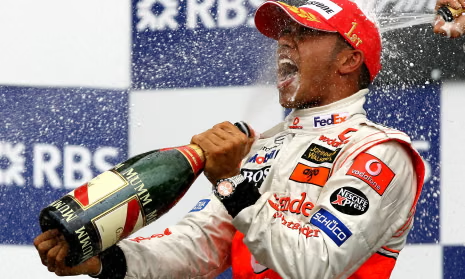
By 2012, Hamilton’s relationship with McLaren had grown strained. The team that had nurtured him since childhood was no longer giving him a car capable of consistent championship challenges. He made the decision that would define the second act of his career: he left McLaren to join Mercedes.
At the time, it was widely ridiculed. Mercedes had won just one race in the previous three seasons. Pundits called it a gamble, a mistake, a step backward. Hamilton was replacing the retiring Michael Schumacher — the very man whose records he would eventually break — but few believed Mercedes could challenge for titles.
Hamilton saw something others didn’t. And he was right.
When Formula 1 introduced hybrid turbo engines in 2014, Mercedes had the best power unit on the grid by a devastating margin. The Silver Arrows won 16 of 19 races that season, and Hamilton claimed his second world title in a ferocious battle with childhood karting friend and teammate Nico Rosberg.
What followed was the most dominant era any single driver has ever enjoyed in Formula 1 history. Hamilton won the championship in 2014, 2015, 2017, 2018, 2019, and 2020 — six titles in seven seasons with Mercedes, an unprecedented run of sustained excellence. The only year he lost during that stretch was 2016, when Rosberg beat him by five points in a rivalry so bitter it destroyed their friendship, and Rosberg retired immediately after winning, as if the effort of beating Hamilton had consumed everything he had left.
The numbers Hamilton accumulated during the Mercedes years are staggering. He won 84 races with the team — a record for any driver-constructor partnership. He took 78 pole positions in Mercedes machinery. He scored 3,949.5 points. He won ten or more races in six different seasons. He led a lap in 58 percent of the races he started for the team.
But among all those statistics, one moment stands above the rest.
Breaking Schumacher’s Record
At the 2020 Portuguese Grand Prix at Portimão, Lewis Hamilton crossed the line in first place for the 92nd time in his career, surpassing Michael Schumacher’s all-time win record. It was a record that had stood for 14 years, one that many believed would never be broken.
Hamilton’s 2020 season was a masterclass delivered under extraordinary circumstances. Racing through the COVID-19 pandemic, in empty grandstands, with a compressed calendar and relentless pressure, he won 11 of 17 races and clinched his seventh world title at the rain-soaked Turkish Grand Prix — equaling Schumacher’s all-time championship record.
Seven titles. 95 wins at that point. 98 poles. The numbers were no longer just impressive — they were historically unprecedented. Hamilton had gone from the boy on the council estate to the most statistically dominant driver the sport had ever produced.
And then came Abu Dhabi.
The Night That Changed Everything
December 12, 2021. The Yas Marina Circuit. A date that will live in Formula 1 infamy.
Hamilton arrived at the season finale level on points with Max Verstappen — 369.5 apiece. It was a winner-takes-all showdown for the ages. Hamilton dominated the race from the front, controlling the pace, managing his tires, driving with the precision of a man who had done this seven times before. With five laps remaining, he was cruising toward his eighth world championship.
Then Nicholas Latifi crashed. The safety car was deployed. And race director Michael Masi made a series of decisions that would shake the sport to its foundations.
Rather than following standard safety car procedure — which would likely have seen the race finish behind the safety car — Masi allowed only the five lapped cars between Hamilton and Verstappen to unlap themselves, leaving Verstappen directly behind Hamilton on brand-new soft tires against Hamilton’s worn-out hards. The race restarted with one lap to go. Verstappen swept past Hamilton into Turn 5 and won the championship.
Hamilton’s team principal Toto Wolff screamed over the radio. Hamilton, stunned, could only manage a quiet conversation with his engineer. The FIA later confirmed that Masi had committed a “human error” and had acted contrary to the regulations. Masi was removed from his position. The result, however, stood.
Hamilton went silent. For weeks, he said nothing publicly. There were genuine fears he would retire. The sport held its breath.
When he finally spoke, it was with the dignity that has always separated him from the noise. “There was a moment where I lost a little bit of faith within the system,” he admitted. But he came back. Because that is what Lewis Hamilton does. Still I Rise.
The Long Road Through the Wilderness
The years that followed Abu Dhabi were the most difficult of Hamilton’s career. Mercedes’s car for 2022 was radically different under new ground-effect regulations, and it was not competitive. For the first time in his career, Hamilton went an entire season without winning a single race. He finished sixth in the championship — behind his young teammate George Russell.
2023 brought marginal improvement but no victories. 2024 offered more of the same grinding midfield existence, punctuated by one magnificent exception: the British Grand Prix at Silverstone.
On July 7, 2024, at the circuit where he had won more times than any driver in history, Hamilton produced one of the most emotionally charged performances of his entire career. In changing conditions, at 39 years old, 945 days since his last victory, he drove his Mercedes to a record-extending ninth win at Silverstone.
As he crossed the line, he broke down in tears on the slowdown lap. In the pit lane, he found his father. They embraced again — just as they had in Brazil in 2008 — and the image of a son and his father, connected by decades of sacrifice and love and racing, moved millions around the world.
“There are times when I thought about giving up,” Hamilton said afterward. “This has taken a long time to heal.”
It was his 104th career victory. And it was, by his own admission, the most emotional.
The Scarlet Chapter

In February 2025, Lewis Hamilton walked through the gates of Maranello for the first time as a Ferrari driver. It was the most seismic driver transfer in modern F1 history — the greatest driver of his generation joining the most iconic team in motorsport.
He drove his first laps at the Fiorano test track wearing race number 44 on a red car, and the images traveled around the world instantly. After twelve seasons and six championships with Mercedes, Hamilton had done the unthinkable: he had started over.
His first season in red was brutally difficult. The SF-25 lacked pace, Ferrari abandoned development midseason to focus on 2026, and Hamilton struggled to adapt to a car built without his input. He finished sixth in the championship, 86 points behind teammate Charles Leclerc, and for the first time since his debut in 2007, he failed to stand on a single Grand Prix podium across an entire campaign.
“This is a nightmare, and I have been living it for a while,” he said in Brazil, his voice carrying the weight of a year that had tested every fiber of his resolve.
But even in that darkness, there were flashes of the old Hamilton. A sprint pole and victory in Shanghai — his first win in Ferrari colors. Recovery drives through the field that reminded everyone watching that his racecraft, his wheel-to-wheel instinct, his refusal to accept a position on the track, remained as sharp as ever.
And then came 2026.
A new regulation cycle. A new car — the SF-26 — that Hamilton had actually helped develop. A second season at Maranello with the culture understood, the relationships built, the rhythms learned. In Melbourne, he finished fourth. In China, he stood on the podium for the first time as a Ferrari driver, claiming third place and ending a 16-month drought.
At 41 years old, in his 20th season of Formula 1, Lewis Hamilton is still racing. Still fighting. Still rising.
More Than a Driver
To reduce Lewis Hamilton to statistics — 105 wins, 104 poles, 203 podiums, 7 world championships, over 5,000 career points — is to miss the point entirely.
Hamilton is the first and, so far, only Black driver to compete in Formula 1. He has used his platform relentlessly to advocate for diversity, equality, and social justice. When the Black Lives Matter movement gained global momentum in 2020, Hamilton did not look away. He took a knee before every race. He wore shirts bearing the names of those killed by racial injustice. He launched the Hamilton Commission, a research initiative to increase representation of Black people in UK motorsport. He pushed Formula 1 — a sport historically dominated by wealthy, white European families — to confront its own failures.
He was knighted by the Prince of Wales in 2021, becoming Sir Lewis Hamilton. He has graced the covers of fashion magazines, walked red carpets, launched clothing lines, co-produced a Hollywood film about Formula 1 starring Brad Pitt. He has become, without question, the most culturally significant racing driver who has ever lived.
But beneath the fame, the fashion, and the seven world titles, there is still that boy from Stevenage. The boy whose father worked three jobs. The boy who had bananas thrown at him. The boy who walked up to Ron Dennis at a ceremony and told him, without a trace of doubt, that he would one day drive for his team.
He didn’t just drive for them. He drove for everyone who was ever told they didn’t belong.
The Numbers
| Record | Hamilton’s Mark |
|---|---|
| World Championships | 7 (tied with Schumacher) |
| Grand Prix Wins | 105 |
| Pole Positions | 104 |
| Podium Finishes | 203 |
| Career Points | 5,059.5 |
| Grand Prix Starts | 383+ |
| Wins at a Single Circuit | 9 (Silverstone) |
| Wins with a Single Team | 84 (Mercedes) |
| Consecutive Points Finishes | 265 |
The Legacy
There will come a day when Lewis Hamilton takes off his helmet for the last time. When he climbs out of the cockpit — whether it is red or silver or some color yet to be imagined — and walks away from the grid for good. When that day comes, the sport will lose more than its greatest statistical champion. It will lose the driver who proved that Formula 1 is not just for the privileged few. That greatness can come from anywhere. That barriers are there to be broken.
Seven championships. Over a hundred victories. Every major record in the book, rewritten in his name.
And still, at 41, there is a dream he holds in his heart. An eighth title that was taken from him on that night in Abu Dhabi. A record that would stand alone, above Schumacher, above everyone who has ever strapped into a Formula 1 car.
Whether he gets it or not, it doesn’t matter. The story is already complete. The boy from Stevenage became the greatest of all time. And he did it his way — with style, with conviction, with courage, and with three words tattooed across his shoulders that told the world everything it ever needed to know about Lewis Hamilton.
Still I Rise.